Showing posts with label be in the know. Show all posts


[Congressional Bills 113th Congress]
[From the U.S. Government Printing Office]
[H.R. 4402 Introduced in House (IH)]

113th CONGRESS
2d Session
H. R. 4402

To authorize the Secretary of the Navy to establish a surface danger zone over the Guam National Wildlife Refuge or any portion thereof to support the operation of a live-fire training range complex.


_______________________________________________________________________


IN THE HOUSE OF REPRESENTATIVES

April 4, 2014

Ms. Bordallo introduced the following bill; which was referred to the Committee on Natural Resources, and in addition to the Committee on Armed Services, for a period to be subsequently determined by the Speaker, in each case for consideration of such provisions as fall within the jurisdiction of the committee concerned

_______________________________________________________________________

A BILL

To authorize the Secretary of the Navy to establish a surface danger zone over the Guam National Wildlife Refuge or any portion thereof to support the operation of a live-fire training range complex.

Be it enacted by the Senate and House of Representatives of the United States of America in Congress assembled,

SECTION 1. SHORT TITLE.

This Act may be cited as the "Guam Military Training and Readiness Act of 2014''.

SEC. 2. ESTABLISHMENT OF A SURFACE DANGER ZONE, GUAM NATIONAL WILDLIFE
REFUGE.

(a) Authority To Establish.--The Secretary of the Navy may establish a surface danger zone over the Guam National Wildlife Refuge or any portion thereof if the Secretary determines that establishment of a surface danger zone will support the operation by the Department
of the Navy of a live-fire training range complex on Andersen Air Force Base, Northwest Field, to support training and operations.

(b) Treatment of Operations.--The operation of a live-fire training range complex on Andersen Air Force Base, Northwest Field, and associated surface danger zone, if established under subsection (a), are deemed to be authorized uses of the Guam National Wildlife Refuge.

(c) Closure to Public.--

(1) Authority to close.--The Secretary of the Navy may close to public use any road or trail within, or any portion of, the Guam National Wildlife Refuge if the Secretary determines that military operations, public safety, or national security require the closure.

(2) Limited area and duration.--The Secretary shall limit a closure under paragraph (1) to the minimum area and period that the Secretary determines to be appropriate for the purpose for which the closure is imposed.

(3) Notification requirements.--Before imposing a closure under paragraph (1), and for the duration of the closure, the Secretary shall--

(A) post and maintain appropriate warning notices regarding the closure; and

(B) take appropriate steps to notify the public concerning of the closure.

(d) Relation to Refuge Management and Uses.--Nothing in this section limits the management authority of the Secretary of the Interior over the Guam National Wildlife Refuge and other uses of the Guam National Wildlife Refuge established pursuant to section 4 of the National Wildlife Refuge System Administration Act of 1966 (16 U.S.C. 668dd) to the extent such management authority and refuge uses are compatible with the authorities provided to the Secretary of the Navy under subsections (a) and (c).


http://beta.congress.gov/bill/113th-congress/house-bill/4402/text?q=%7B%22search%22%3A%5B%22Bordallo%22%5D%7D


Sea Grant Guahan

John Borja takes us around a dreamy volcanic island.
DISCLAIMER: There are no monkeys on Pågan.


informative, with cheesy music!


The Garrido Document

Written by Clynt Ridgell  


http://www.pacificnewscenter.com/index.php?option=com_content&view=article&id=43590:video-1798-garrido-document-reveals-old-chamoru-words-no-longer-in-use&catid=45:guam-news&Itemid=156 
 
----------------------------------------------------------------------------------------------------------

Dr. Carlos Madrid, of the Micronesian Area Research Center at the University of Guam, shows a photo of a document written in Spanish that was translated into Chamorro in the 18th century. The document, which was recently translated from Chamorro into English, had words that either are no longer used or are rarely used today. Photos by Virgilio Valencia/For Pacific Sunday News
A 200-plus-year-old written document in Chamorro has provided valuable insight into the language, according to researchers.

A presentation titled "The Garrido Manuscript: A Unique Glimpse of the Chamorro Language in 1798" was held Thursday at the University of Guam lecture hall.

The researchers, Carlos Madrid, from the Micronesian Area Research Center; Jeremy Cepeda, a research associate with the I Fanlalai'an Oral History Project; and Leonard Iriarte, from I Fanlalai'an, presented some of their findings on Thursday.

In 1798, Manuel Garrido, a Chamorro and official of the Spanish government of the Mariana Islands was asked to translate into Chamorro news received from Manila regarding the victory of Spanish and Filipino soldiers against a British ship attacking Zamboanga, in Mindanao.

The 11-page document offers a rare glimpse of Chamorro language during this time.

One of the biggest findings was that most of the document didn't have borrowed words from Spanish, Madrid said. In the documents, Spanish words that were used were followed with explanations of the item or idea.


Three languages

The translation process required working simultaneously in three languages, Spanish, Chamorro and English, but by the end of the one-year research project, theories regarding many of these unknown words have been formed.

The researchers think that during 1798, despite hundreds of years of Spanish colonization, the Chamorro language hadn't borrowed much from the islands' colonizers.

One theory presented on Thursday is that Chamorros in the villages who were isolated were able to retain much of the language. It was during the 1800s, with more Chamorros moving to Hagåtña and other villages with Spaniards, Filipinos and others, that the language changed.

Madrid said these theories are exciting and can help explain how the language changed over time.

"This provides us great insight," he said.


'Thank you very much'

One of the things they found is how Chamorros said "thank you very much" in 1798 versus the way it's said today.

In the document, Garrido writes "Migai na Si Yu'os Ma'ase." In Chamorro today, it would be said as "Dangkulu na Si Yu'os Ma'ase."

Another word that changed over time is the word for "this."

Garrido used the word "ayen" or "adyin," while Chamorros today use "este" -- borrowed from Spanish.


Preservation

Cepeda said it was exciting to be able to look at the document and find words that Chamorros may not use anymore. He said he's hoping researchers can use the words they find and try to incorporate them back into the language or at least preserve them on paper or in chant.

"This was a really great project to work on," he said.

Dr. Carlos Madrid, center, of the Micronesian Area Research Center at the University of Guam, speaks to the audience about a recently translated document written in the 18th century in Chamorro.Photos by Virgilio Valencia/For Pacific Sunday News


http://www.guampdn.com/article/20140330/NEWS01/303300014/Document-sheds-light-Chamorro-language

ON MILITARIZATION OF PAGAN

Northern Islanders Consider Class Action Lawsuit
Friday, March 28, 2014
Saipantribune.com


Former residents of the Northern Islands and those who have ties to the area are threatening to file a class action lawsuit against the U.S. military if the planned militarization of Pagan pushes through.

This consensus was made following a two-hour town hall meeting Wednesday night at the Carolinian Utt in Garapan where those who attended also said they feel neglected.

“We are mostly looking at getting the focus together and pushing the interest they [Northern Islands] have for islands in the north. Because nothing is being done for the folks of the Northern Islands,” said Jerome Aldan of the Northern Islands Mayor’s Office.

He pointed out that Commonwealth laws also apply to the Northern Islands because they are part of the CNMI, yet “it seems like they treat the Northern Islands differently and are excluded from all these privileges…privileges like homesteads.”

“For many years the Northern Island folks are lost. They don’t know what is going on and how to get their lands back prior to being exiled here to Saipan after the volcanic eruption,” Aldan added.

The Northern Islands Mayor’s Office earlier said that in the past 20 years alone, 18 applications for land for agricultural homestead for the Northern Islands have remained pending with the Department of Public Lands.

Aldan said that a census conducted in 1969 showed that Pagan was home to 49 residents. The oldest resident was born in 1903 while the youngest was born in 1968.

Saipan and Northern Islands Municipal Council adviser William Torres, who also made a presentation at the meeting, said that just recently the House of Representatives passed House Bill 18-108 to force DPL to issue homesteads to residents of the Northern Islands.

Northern Islanders Lino Olopai, Cecilia Kaipat Selepeo, Moses Castro, and others also expressed concerns about the future of Pagan.

Castro said that he was born in the Northern Island on Sept. 19, 1942. “I got married there and had three kids, but after the volcano erupted we were sent here,” he said.

Olopai said the government seems to be waiting for a bigger investor to develop the Northern Islands. He also highlighted the clash between Western concept of ownership and the indigenous rights to their property.

“Like this slipper [that I’m wearing], do I need legal documents just to own this slipper? Do I need a lawyer to go through court to own this? Olopai said in Chamorro. “Why not the traditional way? This slipper will get passed on to my children, then it’ll pass on to their children, then generations to come. That’s the traditional way, our property needs to continue to get passed through the generation with no documents,” he added.

Selepeo told Saipan Tribune about her late father, Francisco Borja Kaipat, the first district representative of the Northern Islands who was assassinated in April 1972.

“The following day we had no choice but to come to Saipan from [Pagan]. My mother was shot in the head. My brother who was 11 years old at that time was shot in the shoulder but he had to be brought to Guam,” she said. “But also because our mother was disabled, we had no choice but to stay here.”

She was born in Pagan in 1970 and has longed to go back to her birth island. Last year on August 2013, she finally managed to join a trip going to Pagan.

“To finally reach the place 42 years later brought back a lot of memories. That’s why when I came back to Saipan after the trip I felt that I needed to get a property up there,” she said.

Now that she is in her 40s she is willing to go back to Pagan, which she described as a healing place.

Aldan said that it is sad to see that nobody is entertaining their concerns.

“It’s all a mater of justice to these folks, they’ve waited so many years. Some of our ancestors, elders, and some folks of the listed census for the Northern Islands are probably gone as we speak right now,” he said.

“Despite where you are in the Northern Islands, we are still in the CNMI,” he added.


http://www.saipantribune.com/newsstory.aspx?newsID=154608&cat=1 


Viewed by Itself, Pacific Islander Experience Looks Very Different (Full Report) 


Empowering Pacific Islander Communities and Asian Americans Advancing Justice


Native Hawaiian and Pacific Islanders lag the rest of the country in attaining college degrees, according to a new report released jointly by Empowering Pacific Islander Communities and Asian Pacific Islanders Advancing Justice.

Pacific Islanders are often grouped with the much larger population of Asians-Americans. For one, their countries of origin share relative proximity, and joining forces helps create the critical mass needed to advocate on policy issues.

But a new report released Tuesday morning underscores just how much more difficult the Pacific Islander experience can be when it comes to education, health and staying afloat financially.

“Those are some of the issues that in many ways are undergirded by poverty,” said Iosefa Aina, an associate dean at Pomona College and a board member for Empowering Pacific Islander Communities, or EPIC.

EPIC, which is based in Los Angeles, co-authored the report with frequent collaborator Asian Americans Advancing Justice. The groups say the report is one of the most detailed looks at Pacific Islanders living in California and other parts of the mainland.
Key findings show:

  • During the recession, the number of unemployed Pacific Islanders rose more than any other racial group — 123 percent — and the number living in poverty grew by 56 percent.
     
  • Rates of diabetes and obesity are higher than the national average. Aina said that has a lot to do with sedentary lifestyles and consuming processed food because of the low cost and accessibility.

  • About 18 percent of Pacific Islanders, including Native Hawaiians, have a bachelor's degree, lower than the national average. In this regard, they share some similarities with some immigrants from southeast Asia for whom rates of educational attainment also lag the general population.


Joanna Lee, a principal researcher with Asian-Americans Advancing Justice, said the report will help show policymakers that the Asian & Pacific Islander community is not a monolith.

While the number Native Hawaiians and Pacific Islanders living in the US now tops 1.2 million, that's "masked under the 18 million or 17 million Asian Americans that live in the country," she said.

"So it's really important to look at this data to really understand the community and understand how to better serve the community," Lee said.

California is home to the largest Native Hawaiian and Pacific Islander population outside of Hawaii. Aina said that many households took root in the state after World War II , when many people moved to the mainland to serve in the military and were followed by relatives.

Population growth has been steady in California over the last decade. The Native Hawaiian and Pacific Islander community has expanded 29 percent to nearly 286,000 people.

Despite some discouraging news in the report, Aina described the potential for change, especially within the community's large segment of young people. (The median age is 26.5 for Pacific Islanders, the lowest among racial groups.)

“What we see is an opportunity to train our young people, to build the capacity within our community to do research, become doctors and lawyers," Aina said.
Read the full report here:


"Our quest should not be for a revival of our past cultures, but for the creation of new cultures which are free of the taint of colonialism & based firmly in our own pasts. The quest should be for a New Oceania."
-Albert Wendt


Hawaii, Alaska and Territories Team Up Against the Jones Act


Posted: Updated:

Main Entry Image
Stewart Sutton via Getty Images

HONOLULU (AP) — Lawmakers from Hawaii, Alaska, Puerto Rico and Guam are teaming up to pressure the U.S. government for relief from a maritime law passed in the 1920s.

The Jones Act was designed to protect the domestic shipping industry. It states that only ships made in the U.S. and flying the country's flags can deliver goods between U.S. ports.

That means that a cargo ship filled with goods from China can only make one stop in the U.S. at a time. It can't stop in Hawaii to exchange goods before heading to Los Angeles.

Hawaii state Sen. Sam Slom says the law punishes the people of Alaska, Puerto Rico, Guam and Hawaii with high costs of living.

Representatives from the impacted states and territories met in a videoconference Thursday.

"All of our areas are specifically impacted by the Jones Act," Slom said. "It is now known that the Hawaiian cost of living, primarily because of our additional shipping cost and because of the Jones Act, are now 49 percent higher than the U.S. mainland. And this is becoming unbearable. It's difficult for individuals. It's difficult for families. It's difficult for small businesses as well.

Slom is part of a bipartisan group of Hawaii lawmakers pushing Congress to reconsider the Jones Act or to consider a waiver for noncontiguous states and territories. Slom said it costs about $790 to ship a 40-foot container from Los Angeles to Shanghai, but it costs $8,700 to ship the same container from Los Angeles to Honolulu.

Alaskan lawmakers have made a similar request to Congress, but the state hasn't yet seen results, said Alaska state Sen. Fred Dyson. Like Hawaii, the state brings in most of its goods by ship or airplane.

Most of Alaska's goods move along the coast, and freight rates would be drastically reduced if the state could use foreign ships, he said.

The American Maritime Partnership, a coalition that represents vessel owners and operators, unions, equipment yards and vendors, says the Jones Act is critical for economic and security reasons. It says the domestic maritime industry is responsible for nearly 500,000 jobs and more than $100 billion in annual economic output.

The Puerto Rico Senate passed a resolution calling for an investigation of the economic impact of the Jones Act, Puerto Rico Sen. Rossana Lopez Leon said. Studies by the World Economic Forum and Federal Reserve Bank in New York have concluded that the Jones Act hinders economic development in the commonwealth, she said.

"If we truly want to create jobs and boost our economic development, we need to eliminate the implementation of the Jones Act in Puerto Rico," Lopez Leon said.

The territory of Guam is currently exempt from the Jones Act, but because natural shipping lanes pass through Honolulu the law affects Guam.

Rep. Gene Ward of Hawaii said the state isn't asking for much, just a waiver from the rules. "Having something made, flagged, and owned by America is obsolete," said Ward, a Republican.

The cost of building ships in the U.S. is five times higher than constructing comparable ships in Japan and South Korea, said Michael Hansen, president of the Hawaii Shipper's Council, an association that represents the interest of cargo owners. There also are far fewer ships built in the U.S. than abroad.

"The extraordinarily high cost of shipbuilding and the artificial shortage or commercial ships in the U.S. creates a narrow and highly concentrated domestic shipping market," Hansen said.

The group agreed to stay in touch and meet again to coordinate efforts.

"The general population is utterly ignorant of either the Jones Act or its implications for us," Dyson said. "We have a job to do to explain what the savings would be."


 http://www.huffingtonpost.com/2014/03/13/hawaii-alaska-jones-act_n_4961203.html

Protect the Sacred : Pohakuloa


Epic King Tides Offer Glimpse Of Climate Change In Marshall Islands
By Joanna M. Foster on March 6, 2014 at 3:13 pm


As the Majuro shoreline erodes, coconut trees fall into the ocean.
CREDIT: A.P. Images

Hundreds of people who had to flee their houses earlier this week as flood waters tore through Majuro, the capital of the Marshall Islands, are now returning home to pick up the soggy pieces.

On Monday, nearly 1,000 people in Majuro and another 246 on the island of Arno, were forced to evacuate by epic king tides that inundated the low-lying communities. Many parts of Majuro Atoll are just 30cm above sea level and the islands as a whole are on average just 2 meters above sea level.

While no deaths or serious injuries have been reported, a state of emergency has been declared and at least 70 homes have been severely damaged.

Disease is also a concern as the floodwater poured through a landfill and disturbed parts of a cemetery.

The Marshall Islands are a string of more than 1,000 low-lying islands and coral atolls in the North Pacific Ocean that are home to more than 70,000 people. The highest point, anywhere on the islands is 10 meters above sea level.

Last June, high tides, combined with up to 8 foot storm surge, left much of Majuro under two feet of water. The seawall that protects the Majuro airport was breached and the runway along with many coastal roads were flooded. Even the President’s house was badly damaged by water.

Senator Tony de Brum, the Minister Assisting the President, told the Australian Broadcasting Company (ABC) that while king tides aren’t new in the Marshall Islands, the level of destruction caused this week was not normal.

“This is far, far from being a normal situation,” he said. “I put that down to climate change… these things are far more intense than before and leave more destruction behind than they used to.”

This week’s floods are being called the worst in decades.

King tides occur periodically when the sun and moon align during perigee — the point at which the moon’s orbit passes closest to Earth. Sea level rise is exacerbating just how high these king tides turn out to be. And unfortunately sea level is rising faster in the Central-West Pacific than anywhere else in the world.

The Intergovernmental Panel on Climate Change (IPCC) estimates that sea levels will rise between 28 and 98 cm by the end of the century. If the higher estimate proves right, about two-thirds of the Marshall Islands will be underwater by 2100.

In his comments to ABC, Mr. de Brum also called on Australian political leaders to do more to help the Pacific deal with climate change.

“When the king tides come, and the salt inundates, it doesn’t go away,” he said. “The salt remains in the soil and in the groundwater. If the people of Australia understood a little better and were able to see the kind of effect that climate change is having on the small island countries I am sure they will have something to say to their leadership.”

The Marshall Islands have spearheaded efforts to forge international action on climate change. In September, the Pacific Islands Forum — which includes the Marshall Islands, Australia, New Zealand, and 14 other nations — issued the Majuro Declaration, calling for increased measures to curb climate-altering emissions. The Marshall Islands also committed itself to setting an example for the rest of the world by converting schools and hospitals to solar energy. Through funding from the World Bank, the country is exploring the option of contracting an ocean thermal energy conversion (OTEC) plant.

In April, the Marshall Islands will host a meeting of the Cartagena Dialogue for Progressive Action, an organization of countries pressing for an international climate agreement that formed after the disastrously ineffective 2009 summit in Copenhagen.

Ultimately, however, migration may be the only option for many islanders. Already there has been mass migration within the country, as people from the outer atolls stream into Majuro. While Majuro is far from being high ground, it does offer people, no longer able to live off the land in areas where salt water has crept into wells and agricultural lands, alternative ways to make a living.

This internal migration, nearly 2,000 people between 2006 and 2011, may have contributed to the level of destruction seen during this week’s king tide. Radio New Zealand International reports that as more and more people have moved to the city, an increasing number of homes have been erected on ever-more marginal land near the water’s edge.

Longer term, the struggle of the Marshall Islands may come much closer to home. Hawaii expects to see massive migration in the years to come. That’s because the Federated States of Micronesia (FSM), the Republic of the Marshall Islands and the Republic of Palau have an agreement with the United States known as the Compact of Free Association that allows island residents to travel to and live in America. In exchange, the United States retains control over access to the waters around the islands.


http://thinkprogress.org/climate/2014/03/06/3372301/marshall-islands-flood-king-tide/


Micronesians Continue To Seek Justice On The 60th Anniversary Of The Castle Bravo Nuclear Test


On March 1, 1954, the U.S. detonated its largest nuclear bomb on Bikini Atoll. Sixty years later, the U.S. continues the militarization of the area, and in exchange, Micronesians are allowed limited access to America.

Carl Mydans / Via digicoll.manoa.hawaii.edu

The U.S. conducted at least 67 nuclear tests in the Marshall Islands between 1946 and 1958. The nuclear test conducted at Bikini Atoll on March 1, 1954, Operation Castle Bravo, remains the largest test ever conducted by the U.S. and yielded 15 megatons, almost 1,000 times the power of the bomb dropped on Hiroshima.

Bravo vaporized two surrounding islets and sent a plume of highly radioactive debris floating over the lagoon and into the open water. Atolls downwind of Bikini, including Rongelap and Utirik, hadn’t been informed of the tests but were showered with dangerously radioactive ash, which residents believed was snow — something they had never seen.

In the years following the test, people who were exposed burned from the radiation, became nauseous, developed thyroid problems, had loss of blood cells, and women who were pregnant miscarried. And decades after the bombings, the health problems persist with unusually high rates of birth defects and cancer among Micronesians.

Even today, the fallout impacts the environment, where it is remains unsafe to eat coconuts, other crops, and fish around these islands. As a consequence, most Bikinians have given up the dream of ever returning to their home, and many Micronesians have left their islands for America.

The anniversary of Operation Castle Bravo is a national day of mourning in the Marshall Islands.

The Micronesians were great navigators who journeyed originally from Southeast Asia some 4,000 years ago.

Robert Kiste
They led subsistence lifestyles off the land and ocean.


The Marshall Islands were ground zero for the atomic testing, but the surrounding islands in Micronesia were also impacted by the nuclear tests and the militarization of the area, during and after World War II.

The Marshall Islands were ground zero for the atomic testing, but the surrounding islands in Micronesia were also impacted by the nuclear tests and the militarization of the area, during and after World War II.
Shutterstock

Micronesia includes Republic of the Marshall Islands (RMI), the Republic of Palau, the Federated States of Micronesia (FSM), as well as other nations. All of these places have their own cultures and languages.

The Marshall Islands are an archipelago made up of of five islands and 29 atolls, each consisting of many islets, which run in two parallel chains.

The Marshall Islands are an archipelago made up of of five islands and 29 atolls, each consisting of many islets, which run in two parallel chains.
Shutterstock

An atoll is a ring-shaped island that encircles a lagoon. The atoll sometimes only partially closes around the lagoon and may be made up of smaller islets.

Most directly affected during the nuclear tests were Enewetak and Bikini in the Marshall Islands.

Carl Mydans
 
Carl Mydans
Carl Mydans
In 1946, Cdre. Ben Wyatt told the 167 residents of Bikini Atoll that due to their home’s remoteness it had been selected as the site for the first peacetime test of the atomic bomb.  Wyatt assured the Bikinian Chief Juda Kessibuki that an authority “higher than any on earth” would look favorably on such a deed and that it would be “for the good of mankind.”

Less than a month later, the Bikinians packed up all their possessions into a Navy transport.


They said good-bye to their home, but they did not know it would be forever.

Nuclear radiation impacted the surrounding atolls as well.


In 1983, Darlene Keju-Johnson spoke at the World Council of Churches Assembly in Vancouver, giving voice for the first time on an international platform to the injustices Micronesians faced as victims of the nuclear age. 

She spoke in particular for the people who lived in the islands surrounding the nuclear test sites. Keju-Johnson grew up on Wotje, one of many atolls downwind of the nuclear tests at Bikini and Enewetak, and she died of cancer in 1996.

In 1986, the U.S. signed the Compact of Free Association with the FSM and RMI.

In 1986, the U.S. signed the Compact of Free Association with the FSM and RMI.
The 4th Branch / Via the4rthbranch.com

The agreement said the U.S. would promote self-governance and economic development so these nations could be self-sufficient. COFA citizens would also be granted the right to live in the U.S., where they can work or study and are required to pay local, state, and federal taxes. They are also allowed to join the military. In the beginning, they were eligible for many of the same benefits as citizens.

A deal with defense.

A deal with defense.
U.S. Missile Defense Agency / Via Flickr: mdabmds

The U.S. military remains very active at Kwajalein Atoll, and in 2012 they performed their largest and most complex missile defense test to date.

In exchange, the COFA agreement gives the U.S. exclusive access to the Marshall Islands’ Kwajalein, the largest atoll in the world, where the $4 billion Ronald Reagan Ballistic Missile Defense Test Site is located.

A similar COFA contract was enacted with the Republic of Palau in 1994.

A similar COFA contract was enacted with the Republic of Palau in 1994.
jimney/jimney

This agreement took the longest to reach because the Republic of Palau’s constitution proclaims the nation as nuclear-free. The United States, which neither confirms nor denies the presence of nuclear weapons as a policy, essentially pressured Palau to abandon its commitment to being nuclear-free. 


Even though they are trust territories of the U.S., all three COFA nations are considered self-governing and receive their own seats at the U.N.

Pool / Reuters
Adam Hunger / Reuters
AP Photo/Justin Lane, Pool

Palau, FSM, and RMI are the United States’ closest allies and almost always vote along with the U.S. and Israel even when other allies do not.

Broken promises.

In 1996, Congress restricted access to government programs for certain people in the U.S. who were not citizens, including people from COFA nations. Because of this, many COFA citizens lost their access to health care, even though they are legal residents in the U.S. paying taxes.

Meanwhile, back in FSM, RMI, and Palau, the U.S. had not lived up to its side of the agreement to promote economic development. Radiation continues to affect many islands, and Micronesians remain dependent on American assistance.

Joakim “Jojo” Peter, a Micronesian community leader from FSM’s Chuuk who is currently earning his Ph.D. at the University of Hawaii, told BuzzFeed there is still “a lot of frustration” for Micronesians, because they have “guaranteed almost forever” the continued militarization of their home while being denied access to health care.

“The fact that a couple of their island atolls are still not habitable, that is testament to a long problem. The fact that there are still people being treated for long-term illnesses, that is testament too,” Peter said. “If there are two groups here, on one side us, Micronesians, and on the other side the United States, we’ve given all we can to this, and then what are we fighting for — welfare. I mean, the
weight of this is so lopsided.”


jimney/jimney

Additionally, Micronesians are concerned about climate change and rising seas, since their islands have a median height of 7 feet.

Compounded with all of these concerns, more than a third of Marshallese — about 20,000 — and more Micronesians from FSM and Palau have migrated to the U.S. in search of better education, job opportunities, and medical care.

“How do you deal with a culture that has gone through this … the trauma of going through being moved, of radiation,” said Dr. Neal Palafox, a professor at the University of Hawaii Cancer Center with a focus on Marshall Islanders, “the trauma of your culture changing.”

Micronesians mostly move to Hawaii and the West Coast, while a large community has also formed in Arkansas, where Marshallese have sought out higher-paying factory jobs at Tyson Foods.

In addition, Micronesians in seeking different options have disproportionally served in the military, and many people in Micronesia know someone who has died in the military.


           Masahiro Sugano / Via Studio Revolt

Kathy Jetnil-Kijiner was born on Marujo but moved to Hawaii when she was 6. She’s a poet who gravitated toward spoken word, as a means to connect with her own culture, which relies heavily on oral storytelling, and new audiences.

In 2012, she represented the Marshall Islands at Poetry Parnassus, an international gathering of poets, with her poem “History Project.”

“I noticed so few Americans noticed anything about nuclear testing that was conducted in the Marshall Islands,” Jetnil-Kijiner told BuzzFeed about writing the poem, “and that’s really frustrating for me and a lot of Marshallese, that no one seems to be aware of this travesty that occurred — and I just wanted more people to know about the horror of it and about what we lost.”

Robert Kiste / Via digicoll.manoa.hawaii.edu

Correction: A previous version of this article misstated that the Castle Bravo bombing was the largest nuclear bomb, when it was in fact the largest nuclear bomb used by the U.S. (3/1/14)


http://www.buzzfeed.com/mbvd/micronesians-continue-to-seek-justice-on-the-60th-anniversar


Who's Got the Biggest Bombs ?


"1945-1998" Multimedia artwork by Isao Hashimoto
2,053 - This is the number of nuclear explosions conducted in various parts of the globe. The number excludes both tests by North Korea (October 2006 and May 2009).

About "1945-1998" ©2003
"This piece of work is a bird's eye view of the history by scaling down a month length of time into one second. No letter is used for equal messaging to all viewers without language barrier. The blinking light, sound and the numbers on the world map show when, where and how many experiments each country has conducted. I created this work for the means of an interface to the people who are yet to know of the extremely grave, but present problem of the world."


"Do you care, do you care Ronald Reagan?
Overkilling not our style, we want peace"


A song by the group Huarere, performed at a rally during the Nuclear Free and Independent Pacific conference in Vanuatu, 1983. From the program "A Nuclear Free and Independent Pacific"

Pågan Island featured on Talk Nation Radio


Michael Hadfield is a Professor of Zoology and Principal Investigator at the Kewalo Marine Laboratory, University of Hawaii, and at the Pacific Biosciences Research Center. He discusses the need to save Pagan Island, its people and other species, from the U.S. military. See http://savepaganisland.org


Total run time: 29:00
Host: David Swanson.
Producer: David Swanson.
Music by Duke Ellington.
Download from Archive or LetsTryDemocracy.
Pacifica stations can also download from AudioPort.
Syndicated by Pacifica Network.


http://davidswanson.org/node/4322 


Palau President Tommy Remengesau Declares Marine Sanctuary, Bans All Commercial Fishing

ABC

Palau's President Tommy Remengesau has declared the Pacific nation will become a marine sanctuary, where no commercial fishing will take place. 


Mr Remengesau has told a UN oceans conference Palau's 200 nautical mile Exclusive Economic Zone will be a "100 per cent marine sanctuary", and commercial operations will be banned within the Pacific nation's territorial waters.


"We have no choice - the ocean is our way of life," he said.

"It's our livelihood, it's our culture, it's our economy - I always say the economy is our environment and the environment is our economy."

"You may ask why, why are you doing this? It makes every sense for our sustainability as a people, as an island nation, and as a community."

 Seized Shark Fins [Palau Shark Sanctuary]
Palau currently has commercial fishing contracts with Japan, Taiwan and several private companies, which will be allowed to expire.

Mr Remengesau says locals and tourists will continue to be able to fish, but no commercial scale operations will take place.

"I may not be the best fisherman, but I am a fisherman," he said.

"I can tell you that in just my generation I've seen stocks of fish dwindle down, I've seen the sizes of fish taken become more smaller.

"This is something that is far more than the economical loss of revenues for companies or other countries - you're talking about a livelihood that's really going to be decimated if we don't take the responsible action."

The marine sanctuary follows the declaration of a shark sanctuary in Palau in 2009.
Shark sanctuaries have since been declared in several other countries, including the Maldives, Honduras, Marshall Islands and French Polynesia.
[Micronesian Shark Foundation Palau]

Mr Remengesau says a dead shark is worth several hundred dollars, but a live shark is worth $1.9 million in tourism during its life span.

He says his country will promote scuba diving, snorkelling and eco-tourism as an alternative income to commercial fishing.

"We're not just closing our waters and throwing away the key," he said.

"We're closing our waters because we will do our part of making sure that there's healthy stocks of fish in Palau that can migrate to other places, and that there are other options to grow the economy.

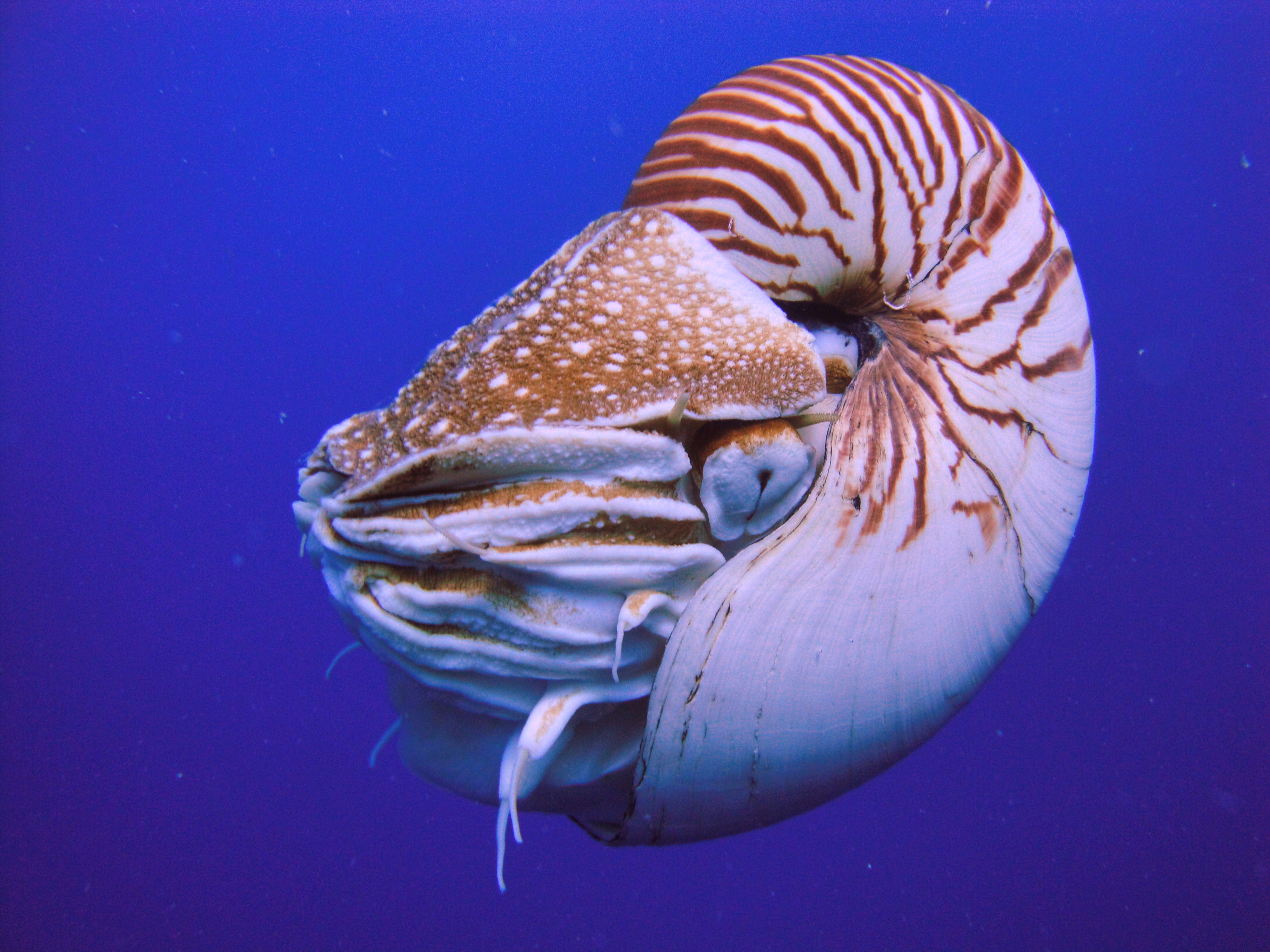
Nautilus, Palau. [Wikimedia Commons]


"These are important ways to make a living and at the same time preserve the pristine environment that we have been blessed with in Palau."

Enforcement of the commercial fishing ban is expected to be a challenge, as the country only has one patrol boat to cover its economic zone which is roughly the size of France.

Last year it trialled unmanned drones, and is also looking for other technology partners to help enforce the ban.

Sustainable Development Goal

Palau is also urging the United Nations to adopt a new Sustainable Development Goal to protect the world's oceans.

The Sustainable Development Goals (SDG) are a follow-up to the Millennium Development Goals, which pledged countries to reduce poverty and improve health and environmental protection by 2015.

Stuart Beck, Ambassador of the Republic of Palau for Oceans and Seas, says the proposal for a 'stand alone' goal has three parts.

"One: healthy oceans - let's clean up the plastic gyre, let stop dumping garbage," he said.

"Two: restoration of our fish stocks - we can actually achieve that in our lifetime if we're smart about it.

"Three: bring some equity to the current resources being taken from these oceans by others."

Mr Remengesau says the health of oceans affects countries in a variety of ways, from rising sea levels, to ocean acidification and unpredictable weather.

"It doesn't matter where you live around the world; we are all connected somehow and are impacted by what we do to the oceans and the health of the oceans and the seas.

"And so it is important that the United Nations in the next Millennium Development Goals, really put a stand alone policy on this."

Deputy Secretary-General with the UN, Jan Elliason, has paid tribute to the Pacific and other island countries for raising awareness of the issue.

"They have an acute sense of the dangers of climate change and the level of sea rise - becoming an existential threat for them," he said.

"They are a bit like the canaries in the coal mine, the canaries that warn us that now the oxygen is [running] out...they're the first ones to leave.

"We should listen to those states."
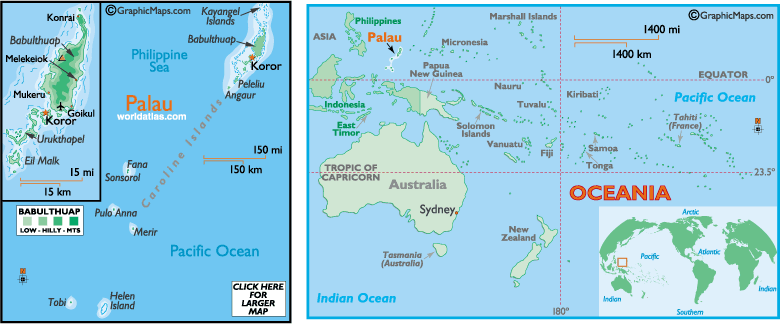
Palau is famous for its Rock Islands.


http://au.news.yahoo.com/technology/a/21295718/palau-declares-marine-sanctuary-bans-all-commercial-fishing/

meanwhile...

Guam EPA Reminder : Fish/Shellfish Advisories Remain in Effect for Cocos Lagoon, Orote Point and Agana Swamp

Guam News  
 
Guam - The Guam Environmental Protection Agency is reminding residents of 3 longstanding fish and shellfish advisories that remain in effect for Cocos Lagoon, Orote Point and the Agana Swamp.

- COCOS LAGOON: A fish consumption advisory for Cocos Lagoon has been in effect since 2006. The advisory stems from fish tissue sampling conducted by the U.S. Coast Guard that indicated levels of polychlorinated biphenyls (PCBs) above U.S. EPA recommended screening value for those fishing in recreational waters. The advisory only applies to consuming fish and does not cover swimming, wading or other recreational activities in the lagoon. PCB contamination in the Lagoon along the Cocos Island shoreline is suspected to have come from the former U.S. Coast Guard Long Range Navigation (LORAN) station on Cocos Island.

2006 marianas variety news article on LORAN station & contamination

- OROTE POINT: A seafood advisory was issued in 2001 for the west side of Orote Peninsula (Rizal Beach to Spanish Steps) and Gabgab beach in Apra Harbor. The advisory extends 600 feet from shore. Seafood caught in these areas may contain polychlorinated bi-phenyls (PCBs), chlorinated pesticides or dioxins at levels that are not safe to eat. This includes fish, shellfish and algae or sea grapes. Fish samples were taken in 2001. The landfill has been cleaned and capped with a low permeability cover. The Agency for Toxic Substances & Disease Registry (ATSDR) advises choosing younger, smaller fish and other seafood to reduce exposure to contaminates whenever possible. Residents are also encouraged to remove skin, fatty tissue in the belly and along the side and internal organs of seafood to reduce potential exposure to chemicals.

more information on Orote Landfill 

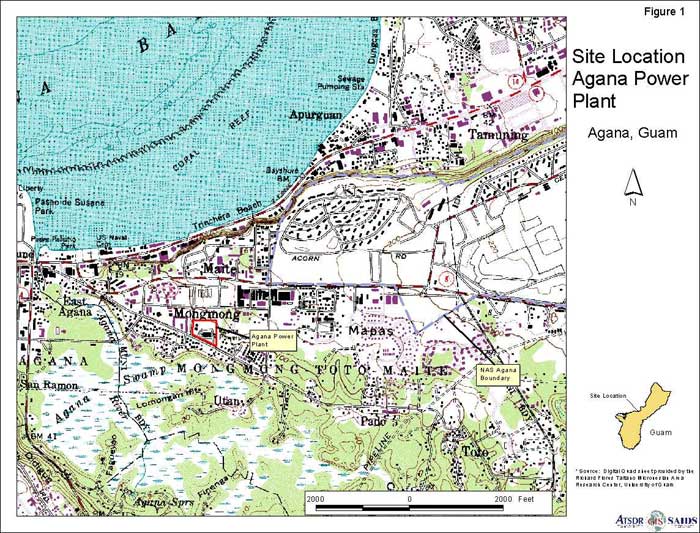
- AGANA SWAMP: An advisory was issued regarding fish and shellfish in the Agana swamp and river in 2000. The advisory was issued after test results showed fish and eels in the river and swamp area had higher levels of Polychlorinated bi-phenyls (PCBs). PCBs were used at the Agana Power Plant and were found in the soil near the electric transformers at the plant and in the Agana Swamp.

more information on the Agana Power Plant


Navy Dredging Could Harm Sea Turtles
Feb. 2, 2014
Written by Michelle Conerly
Pacific Sunday News
Two local sea turtle populations could be affected negatively by work outlined in a new environmental assessment announced by the U.S. Navy.

The Navy is looking to rehabilitate and modernize its existing X-Ray Wharf near Apra Harbor on Naval Base Guam to accommodate larger vessels by creating a fill-supported wharf and two mooring dolphins.

To do so would require both pile driving and dredging, the report states.

Green Sea Turtle.
Dredging is cleaning out a waterbed by scooping out mud, weeds or rubbish with a dredge.

To complete the project, which could take about two years, a total area of about 103,500 cubic yards within 17.2 acres would need to be dredged to get the area to 35 feet deep, said William Austin, public affairs officer at Naval Facilities Engineering Command Marianas.

The report states "the Navy determined that the proposed action is likely to adversely affect Endangered Species Act-protected sea turtles due to elevated in-water noise levels from pile driving."

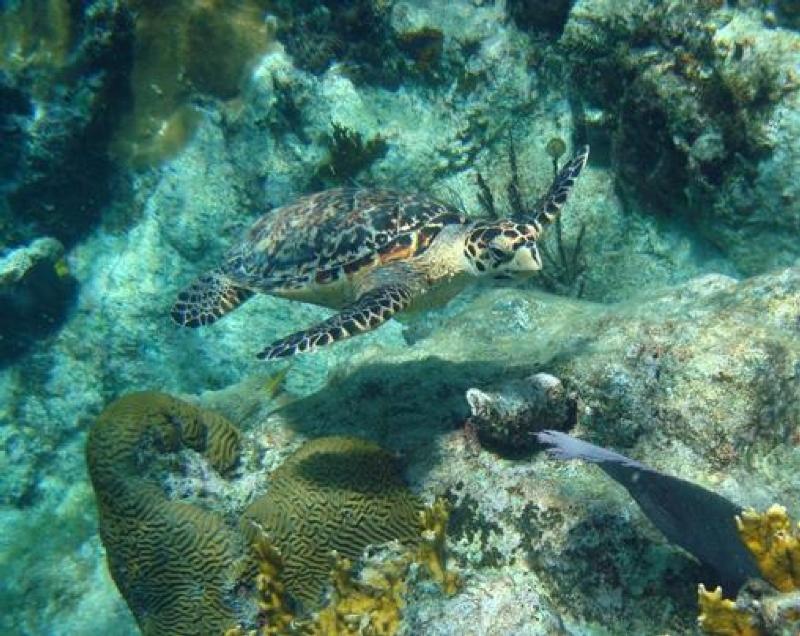
Brent Tibbatts, fisheries biologist from the Guam Department of Agriculture, said hawksbill and green sea turtles are two species that can be found foraging and possibly nesting in inner Apra Harbor, and would most likely feel any negative effects from the military work.

Combined, there are on average 22 sea turtles in the area per year, with peak sightings from July to October, Tibbatts said.

The safety boundary of the pile-driving noise to physically affect the sea turtles is about 150 feet, Tibbatts said, and an approximately 3,000-foot boundary is given before behavioral changes, such as swimming away from the noise, would occur.

Hawksbill Sea Turtle. [nps.gov]
If a turtle were to swim within the 150-foot range of the work, damage could occur to the animal's ears, brain, lungs and eyes, said Tibbatts.

Startling endangered animals and anything else that would affect an endangered species is considered a violation, but the Navy has applied for an Incidental Take Statement, which would allow for the changing of behavior for a short period of time since the work to be done won't cause any permanent damage, Tibbatts said.

In terms of dredging, the efforts by the Navy to control sediments in the past have been inadequate according to Tibbatts, who said that Agriculture would be monitoring that activity to make sure there aren't any disturbances.

The comment period ended this week and the Navy now will review the comments and, depending on the nature of the comment Austin said, they could be incorporated in the final environmental assessment.